
Iran, Iraq, Oil, War and the International Community: NATO, UNO and EU for Limits

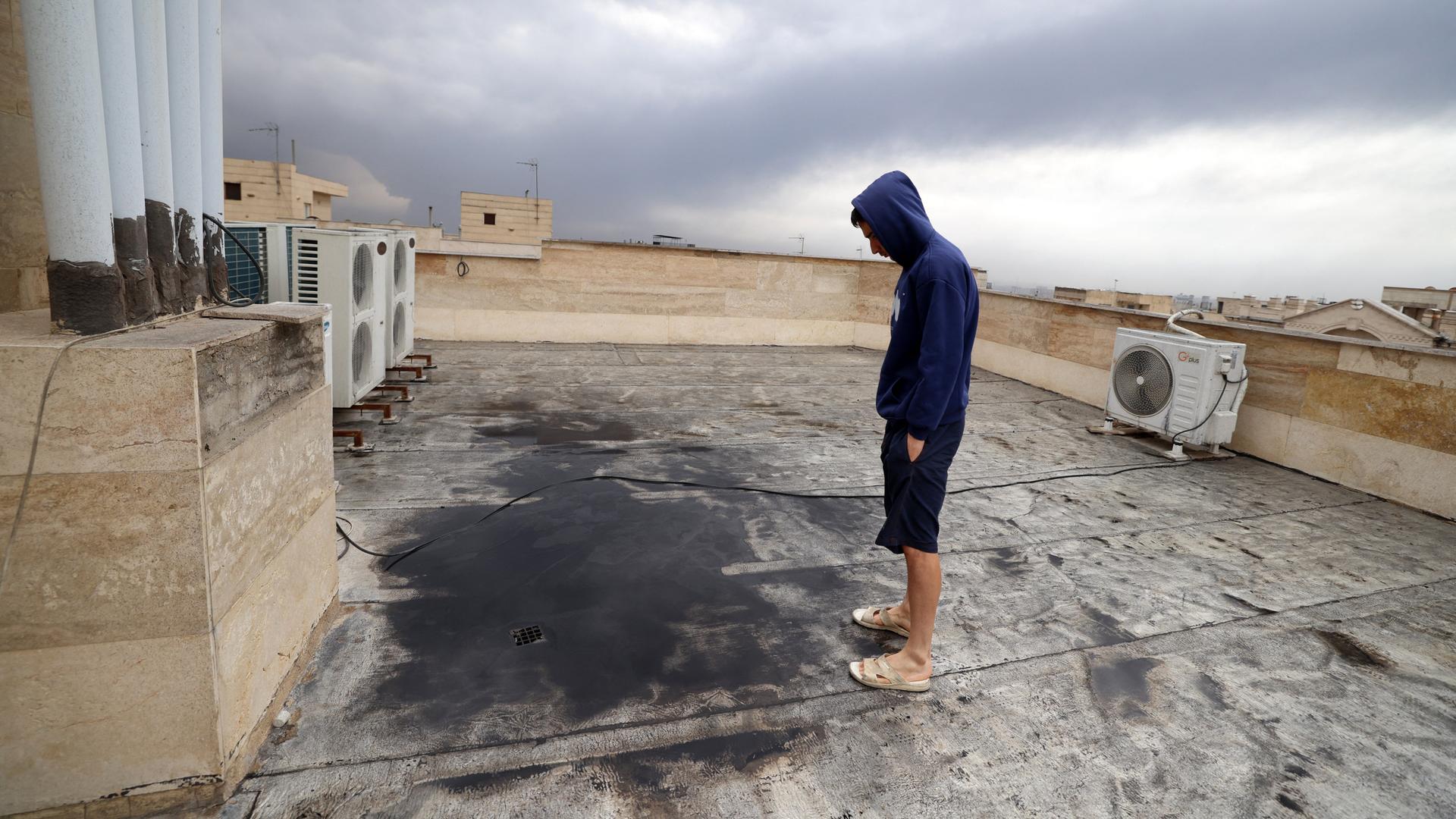
Ein Mann steht auf einem Flachdach und betrachtet eine schwarze Pfütze.
Image: Radio Deutschlandfunk (Germany), “Nach einem Luftschlag auf eine Raffinerie in Teheran ging sogenannter Schwarzer Regen auf Teheran nieder (Bild vom 8.3.2026) (AFP / ATTA KENARE)”

Prices are rising… well, what would one expect. People are being killed. Now the ‘black rain‘ over Tehran is another step towards destruction. The region going up in flames. The country scarred already and becoming another Iraq…?

It’s good to see that they are starting to act again, NATO, EU: ‘Trump’s war’ is not his doing alone, of course.
As a ‘figure head’ he ‘works’ based on the interests behind him too: The industries, most importantly the one producing weapons. The population, who as a majority depend on their ‘way of life’, namely cars for moving across country in the USA, with cheapest prices of all… they trust that any president will observe this concept, this idea, and the government will take care of petrol.

War is no heroic deed of people doing the good thing. War is not only a ‘costly affair’… it always is part of a framework of interests and needs of those in power, those with money and those with ulterior motives. Such goals are not always easy to ‘dig down to’, define.

In the news we usually get the actual event. What we need to do is more reading, to get at the facts behind the ‘images’. Reliable sources. Remember that news have statements in them, which in turn are based on interests and needs and –  very often also on diplomacy.
What also helps to understand the ‘goings-on’ behind the scenes, the real motives, is this age-old concept:

“Cui bono?” – “Who benefits?”

If you ask that about anything, it will get you farther in understanding.

This is no ‘piece of cake’, especially not for those being killed and wounded every day. Being scarred for life by health risks and cruelty and greed.

We need to prove that the international community is stronger holding out against one or another country and their selfish, incompetent and greedy ‘potentates’.

NATO, UNO, EU.

Yes, we can.

“They All Do it…” – What’s Human? – Values and Yardsticks – Happiness…?

Men sitting on floor and meditating in lotus pose meditation practice concept cartoon
Image free license via freepik.com

In this day and age quite a number of people go by marketing ideas: “The most wonderful holiday; adventure; more money equals more happiness; me first.” Many also for most of their lives are more or less unhappy or feel a strange urge or yearning for ‘the real thing’.

There are numerous methods and substances around people revert to as well in order to gain a feeling of fulfillment. Of self-respect/self-esteem. While inside a sometimes half-conscious nagging little voice either asks constantly about their shortcomings. Or about the missing something in their lives that would finally get them to that happy ‘ending’.

They tend to forget that what others talk about in so many words, often boasting (even if in a gentle manner not quite discernible right at first), is not really true. Even if actions actually happened – which also can be doubtful with those ‘building their image’ all day long – their effects usually do not come up to the story told.
Sailors were said to be the ones having invented the art of ‘telling tall tales’. Which puts it in a nutshell, that principle…

In due course also, values and yardsticks for the individual behaviour are not reflected that much anymore: “They all do it… Why not me too?”

Additionally the ideas of patriarchy and its pitfalls as well as changing views on womanhood make it challenging to know your way: Some actually state it just as the old saying goes: “What’s sauce for the goose is sauce for the gander…”  Equality in terms of “if men can do it, women can too.”

These things are crucial about all of this:

    • Something does not become right, just because many people do it, too. Or because no one will realize it…
    • Happiness is not in applause of the many, the crowd. The audience. – Happiness is inside.
    • More money may make you feel safer. But only if you will let it. It won’t make you happier. Especially not if self-esteem is missing. ‘Missing in action’…

Eastern systems of living and health start teaching us (again) what it is that makes humans happier:

Self-awareness that will be the beginning of a new self-esteem. With it comes the realization that looking out for yourself in a healthy manner will also enable you to find new ways of reaching out; connecting. With people of like mind. With real conversations. With the ability to understand that happiness sometimes is to accept our unwanted emotions such as sorrow or worry as part of the whole:

Being part of a community. With many people around who wish us and the whole well  – too.

Happiness is in the small things.

“Vatanam” – Iran: “My Beloved Home Country” – The Pain of Exile

Exile is painful. Always. But the Iranian emotion is special, because there’s a warmth and a feeling of community that is like none other. Exiles all around the world feel it and their ‘ballad’ you might say is this song, a very popular Persian singer of long standing made about that feeling: A heart rending longing and yearning for that singular and most special countryside, landscape and the people who live there.

I am not Persian myself but I was married to one for over ten years. I spent over 20 years in close contact to friends and family. I fell in love with the language when I first heard it. Soft and melodic intonations and a flow of words and sentence melody that can be like a caress.

I learned the language and studied history and culture too, at university. I talked to Persians  and learned about the music, the popular and the classic.

About lyrics and poetry.

Most of all: I learned to love that humour that thousands of years of sad and tragic wars, and attempted conquests, as well as strict rules, imposed by shahs and regional kings, made flower into a fine art.

The warmth and sense of community and the hospitality even towards strangers as well as that wonderful ability to celebrate smaller or larger holidays and festivals.

The sense of helpfulness and community.

The sense of reality at the same time: To know that weaknesses and shrewdness are part of human life. And that for all hospitality you are better off being careful when meeting someone for the first time.

The sense of politeness that is also a fine art you need to learn and after a while works like a charm, a warm shield against vulnerability:
Because the ‘taarof’, scorned by some as being outdated and insincere to my mind is a wonderful method to communicate with a sense of tact and the possibility that people feel hurt easily.

Which is part too, of that sense of passionate emotions being, mostly, an accepted part of human life. And need to be taken care of, not suppressed. In general.

Iran is a country with humans, but that sense also is there, that dignity and respect even when we make mistakes, are due, in general and everyday cases.

‘Vatanam’, this song is to many the epitome to that home and that society, that community that makes you feel at home and welcome even as a stranger.

How to See With Your Heart – People and the Common Denominator – 1 Among 100

Image of a heart shape and a head and brain shape, in red and blue respectively, in front of a black background.
Image by Gerd Altmann from Pixabay

Connecting… To others, feel connected and welcome. The basics of human existence, the basic needs and sorrows and joys.
Knowing about them inside yourself makes your ‘heart’ ‘clairvoyant’: You start to see the other’s pain, their joys, their sorrows, you understand – and you can relate to them in new ways – and find new solutions to old problems.

People are like icebergs, rarely is everything visible at once. It’s a fact that we all know to be true, at least more or less: Especially in business, it’s a common idea that one should be always competent, never make mistakes…, always be fit and never lack enthusiasm. Perhaps even smile, if you can, to show that you are happy.

That means many people, even if half-consciously, behave that way; because we learn early in life from our surroundings, namely parents, family, friends and later kindergarten and school, and so on.

But sometimes people start realizing at some point that there is “more to it than meets the eye”.

Human beings have fine sensors especially as children about what is accepted behaviour and what is not. Therefore starting with early childhood they adapt to what is expected. Thus culture and personal background are decisive aspects of what makes for the personality you meet one day around your workplace. And the personality you are.

The hidden emotions and less accepted tendencies, a yearning, to fulfill an inner need for something else – love perhaps, passion, adventure – can be strong. The self-control usually is too.

Looking Beyond the Image

If we take into account that any culture in this world imposes limitations on people’s behaviour which are basics for that self-control preventing them from speaking up – we will start to be able to look beyond the image. Relate to the true human being behind the business personality.

Daniel Goleman in his bestselling book called it “EQ”: Emotional Intelligence, the ability to realize the emotional side to any human thought and reaction. He states it clearly that science did eventually prove what has been part of literature, music and stories for as long as mankind exists:

Emotions are the basics and central. Without them we become incapable to decide – anything.

That’s how heart and brain are connected – in a nutshell.

Statistics show too that 1 among a 100 people will speak up or contact someone when they have a problem or an issue. Therefore, looking at the small numbers in this respect can be crucial.

That’s why I use this blog to post about perhaps unusual subjects – to some of my readers. In the hopes that one or the other of them finds realization and perhaps even consolation in the fact that they are not alone with those thoughts, ideas or puzzles of human existence.

Understanding our emotions and relate to others better that way, Antoine de Saint-Exupéry put this way in “The Little Prince”:

“Here is my secret. It is very simple: you only truly see with your heart.
What is essential is invisible to the eyes.”


(Reused my own material from previous posts.)

Trump’s Desperation: Oil, Power Games, and War – or: Against a Strong International Community

Four pictures, showing the US-flag on a background of dried, cracking earth, a picture of oil rigs, dollar bills in front, and a picture of a Greenland and Iran map, respectively.
Images licensed via Adobe CC, my arrangement

It’s obvious: Greenland didn’t ‘work’… now it’s back to Iran, again? How in the world do you sleep at night and look into the mirror in the morning, Mr Trump?

Again the scare tactics to get people to succumb to your type of deal conditions? ‘What the he…l?’ This is not your earth, not your and your followers’ planet.

Simply and truly. It’s obvious too that in view of the internal affairs you deign to handle in your usual cruel manner; Minnesota comes to mind; promises you probably have made to the large industries in the US, especially those producing weapons. You need any distraction from those affairs, come hell or high water.

In German for people like you there is a fine term: This urge is called “Großmannssucht”: The dire need to feel tall and important. “Craving for status”. It would be ridiculous if it wasn’t so shameful.

For years you have tortured half the world (at least) with your threats, bullying and tantrums. We all know that you literally stop at nothing.

A criminal ruled guilty on 34 counts.

Once more Oscar Wilde’s “The Picture of Dorian Gray” comes to mind:  a young and sweet-faced man who starts a promising career and then just commits about every crime in the book, because he believes that such a life could make him happy. Which it doesn’t.

After a sort of magical transformation, so for many years his appearance does not change from that young, innocent face, the story ends with him one day looking into that special mirror once more; after many years he sees his face in the actual state nature intended for such people:
The horror strikes him so suddenly that he dies on the spot.

The staff and neighbours running in to help are horror stricken too and do not recognize him for quite some time.

Mr Trump, be aware the international community is strong and they are more. Get your act together and stop these charades.


Author’s Note: Politics around oil for over two centuries now are at the top of all policies that countries and their leaders observe since the need for fuels made from fossils arose ever more strongly.
One prominent centre of attention since that time was – and still is – Iran: The world’s largest industry for mining and marketing oil, it’s been part of the US’s foreign strategic policies for more than a century as well.
The last shah of Iran was put there by their support. He was made to leave when he became unable to control the starving people.
The government after that, cruel and dreadful as far as internal affairs go, has been able so far to resist the attempts at bullying them into subservience.
Iran has a culture that reaches thousands of years into the past, far beyond any more recent religious ideas.
That culture and its strongholds deserve saving. And the people of Iran to be in their own right and possession of the natural resources. Instead of under the order of a government headed by someone like the current US-president.

“Smile and the World Will Smile With You” – or: The Smile of Asia

Four pictures of smiling people
Image by Sasin Tipchai, Yogendra Singh, Hữu Thanh Cái and Tri Le from Pixabay, my arrangement

The smile of Asia as a phrase has been used in advertising – too. But the actual fact is also that in many countries around the world, especially in the Near or Far East, as they are called, smiling at others you never even met before is a custom.

People from other parts of the world often feel charmed and after a while even puzzled by these smiles. Aren’t we friends, when we smile? Or at least close?

There’s another fine line that Rudyard Kipling, English ‘poet laureate’ and award-winning writer, used in his book “Kim”:

“The indifference of native crowds he was used to.
But this strong loneliness among white men preyed on him.”

If you have once encountered and actually felt that atmosphere and met people from those parts, you will come to realize that he was right. It feels exactly that way. That sense of community and friendliness, acceptance of others as human beings can be heart-warming.

I am not originally from anywhere close to those parts. But I have lived with and learned from the Persian culture for the better part of my comparatively long live.

I have come to appreciate that feeling. It is based on the idea, that we of course would need to really meet, get to know the other person in order to be friends. But that as human beings we can be close, because we are similar in our needs and wishes and sorrows and joys; we need each other, in troubled times as well as in joyful times.

According to that nice saying too:
“Sorrow shared is sorrow halfed. Joy shared is doubled joy.”

It can help also to (again) understand that in spite of the advantages the individualism in Western countries has brought, it can make people lonely. The pandemic has increased and sharpened that.

Perhaps the ideas we see daily actually ‘thrown’ at us all around the clock (if we don’t filter them), online that is, about being ever more optimized, the ‘perfect person’, make it more difficult.

The daily live in Asia has developed over thousands of years, climate and living conditions as well as ancient philosophy and customs are part of it. We can learn that:

Smile – and the world will smile with you.

All the Same…? – or: Views and Perspectives – or: Thinking Outside the Box

Majorities seem to be the thing… they are many, they are often loud (not always) and they seem to be everywhere… Really? With a little closer look, taking a different view – taking a step back and looking from the outside we may see more.

A crucial matter is that ‘thing’ humans have: They need to be part of something, of a group, a club, a family, a tribe; people, in short, they fit in with. At least to some extent.

But, since the dawn of time we were not all the same: Some people are gardeners, you might say, some are philosophers, some are mathematicians. Some are … you name it.

Another thing can be that at times people tend to feel irritated or self-conscious or intimidated when faced with new ideas and strange people.

So, belonging is a central aspect. It can become complex and sometimes even painful, when there seems a larger group of gardeners and a small group of philosophers, to stay with the examples. Both sides may feel challenged: One side because philosophers seem ‘strange’. The other because they ‘fit’ differently, elsewhere.

When we know about these facts – the idea that we cannot be all the same, that changing perspectives and recalling what is important in life, is crucial too, we may become able (again) to accept the new or strange idea.

Because we feel grounded in our own world view and still are able to integrate something else, something different. New.

That’s where joy can be found: Combine the old and the new into something fruitful and inspiring.

The IoT: Internet of Things — or: Listening in — or: the (Non)-Smart Home — or: Never Assume

Woman in kitchen holding mobile phone looking at devices with drawn blue highlighted connectors towards her phone
(Image licensed via Adobe CC)

In this world of digital devices and internet connections, faster every day, basically, the so-called IoT, the Internet of Things, for some time now has made a sad appearance and fashion of sorts: The devices connecting to the internet through integrated hardware, such as your Smart-TV, your ‘smart mobile’ — or simply the Smart Home devices such as Siri or Alexa, listen in

Indeed, it’s a fact: If not switched off deliberately, such devices will record and transfer spoken words, in many cases. Just like that…

What is particularly interesting, is the ‘eavesdroppers’ paradise: People who for the sake of curiosity — or simply to gather information — listen and start assuming

I have seen it time and again: People observe or hear certain words or situations – and start assuming… Based on a few facts — and a lot of ‘reasoning’, which in fact is just your basic assumption.

These assumptions can be wrong. A nice example is the clip below from the movie “Desk Set”, with Katherine Hepburn and Spencer Tracy. It makes it clear too, how easily we can be wrong when trying to interpret.

I always think, should you overhear somebody in anger, swearing, letting off steam, as it were — and would assume general views of that person, you might come to sadly wrong conclusions…

I’d like to create more awareness of these things: It’s sooo easy to be mistaken. And can lead to such sad results, depending on the situations…

In other words: Never assume.


Author’s Note: Post reused earlier content

“One Swallow Does Not Make a Summer” – Or: How To Judge – or Not…?

A table in a laboratory sowing several tubes, small glass bottles and testing equipment for chemical substances.
Image free via freepik.com (no AI involved)

In science you make a rule from thousands of occurrences of the same phenomenon… if it is the same. There are strict rules for creating new or even corrected rules in science. The same is true for the law, legislation and courts of law: In order to be sure of what you do or say, you have to be very careful of your facts, and your witnesses, if any.

That’s why in everyday life you meet so many people who judge often based on – almost nothing: One day, one situation, one occurrence, even a chance correlation of two events – and ‘lo and behold’ they make up a story about people, a place – or they pass judgement.

It’s easy that way: Passing judgement, on others. It makes you feel fine(r) about yourself. And you can stop worrying about your own shortcomings…

Well, it depends, of course. Because not everybody is the same.

Even the bible, a book full of wisdom, if you know how to read it, has that, already, Matthew, 7, 3:

“3 And why beholdest thou the mote that is in thy brother’s eye, but considerest not the beam that is in thine own eye?” (King James Version)

“3 “Why do you look at the speck of sawdust in your brother’s eye and pay no attention to the plank in your own eye?” (New International Version)

There’s the idea that two events occurring at the same time can be made into a story… such as a stork flying across the sky while a baby is born… Makes it – what?

“Storks bring babies…?”

Are you quite sure…?

Drawing of a smiling stork flying past carrying a baby inside a folded cloth in his beak.
Image free via Ecosia filtered search, Creative commons

Peeping Toms – and Marys? – ‘Devices and Desires’…

Two pictures, an eye peeping from behind a hole in a wallpaper and the photo of a nightclub sign advertising a peep show
Images by Kev and Tumisu from Pixabay, my graphics

The ‘peeping Tom’ for generations has described aptly what I am about to deal with here: The secretly watching male, who’s too dumb for a vivid imagination and too cheap for spending money on the ‘real thing’:
The male (and female?) person who watches others using any kind of device, in the analogue days telescopes or binoculars, to catch at least glimpses of those others in ‘private states’:
Any stage of undress, close encounters of the private and loving kind they miss out on themselves so sadly…

Perhaps it is no coincidence that ‘a Tom’ is also short for a roving male cat…

It is sometimes sad, sometimes rather annoying, when you realize them being about – and often just plain ridiculous and proof of very small minds.

They are not using the – especially these days – ample means and opportunities that often are even sold cheap online; not using the human imagination based perhaps on tales or books or even movies to make their own ‘reality’…

Woody Allen let one of his characters put it nicely in his comedy “Bullets over Broadway”: ‘reality is for those who cannot make their own.’

These days I presume, with so-called – in this respect – equality of the sexes around – women might be ‘peeping’ too; but that is a guess.

Just as in former centuries (married) men used to boast about their ‘adventures’, the nice term ‘swaggering’ makes it even clearer; while women were the ‘true gentlemen’, who relished in silence, even though from necessity rather than want…

To this day, the statistics in these matters especially are hard to determine and not easily published. Not all that is loudest is the most of any kind – nor right….

The right to privacy is a human right and apart from an invasion into the privacy of those that are watched, it’s a punishable offence

Still, to put not too fine a point to it… all those who read this and start thinking: Perhaps new ways can be found, anyway:
There are those that seem to be the natural counterpart of peeping Toms or Marys: the exhibitionists…

So, inhibited masses, unite!