“My Way” is a song first rendered in French, actually: Comme d’habitude. The English version has the same melody but different text, saying that a full life can mean to do it ‘your way’. To me there’s of course community. Or the necessities of earning a living. But preferably with things I love to do. In my case that’s texts and technology, being a technical writer.
Yet, in my free time I like to listen to my inner rhythms. The ‘clock’. The necessities arising from an eventful professional life and other considerations, making it a challenge at times.
I’ve learned doing Yoga routines. I know about Ayurveda and Traditional Chinese Medicine. Enough to know that being at one with yourself can mean:
“Less is more.”
Circadian rhythm refers to the fact that the sunlight and darkness means something to our everyday life. There’s a lot of scientific research around by now and they confirm the age-old systems I just mentioned.
It may also depend on the phase in life we go through which can mean that adventure or eventful days are aimed at.
But “the times they are a’changin’.” In other words, to be able to live calmly and quietly, doing the mundane things, really, such as writing here; exchanging ideas. Or have a fine, late breakfast on a holiday, with friends even, can be the ‘order of the day’.
Blissful living in the true sense of the word.
“Agentic AI” – short for AI workflows you save or set up to reuse and even combine. A little like those macros in MS Office at the time they were popular, before their potential to introduce malware became known.
Well, it reminds me of those thrillers a little: In general, AI can be a help and a fine tool, no doubt about it.
But it also is comparable to knives. In the wrong hands it can do a lot of damage.
How Do I Know?
I am a technical writer by profession and documented AI successfully, with the support of a mathematician and other SMEs. That documentation in 2019 even was mentioned specially by the US-agency Gartner in their Magic Quadrant on Metadata Management Applications.
What I find extremely irritating is the fact that – agents or no agents 😉 – it’s constantly being pushed on me: Not just those pop-ups, but actual AI chat boxes instead of searches. Big, first time logging in, as if nothing else existed.
Paid services or not: I hate being forced to use a technology whose results are doubtful at times and have to be checked and checked backwards again.
I know that selling these days can be hard. Kudos to all sales and marketing people who try it anyway. These days especially where only wars seem to be able to let markets ‘look up’…
Still, forcing it on me is like trying to sell a cookie by forcing me to eat it… Imagine someone being allergic to nuts and having to eat a ‘nutty’ cookie…
Can drive you ‘nuts’… ┐( ͡◉ ͜ʖ ͡◉)┌
UTC (+1) Friday, March 20, 2026, 15:45:59 PM (Berlin, Vienna)
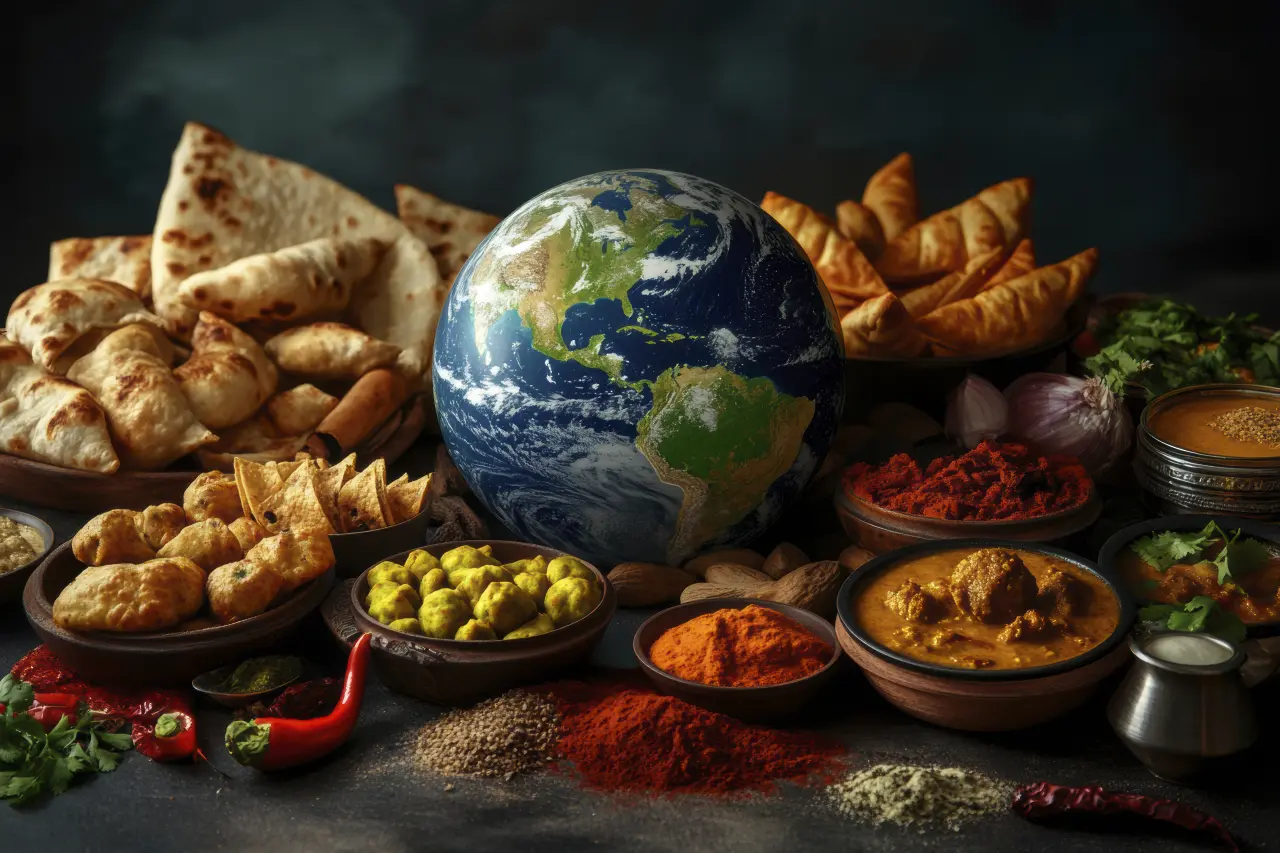
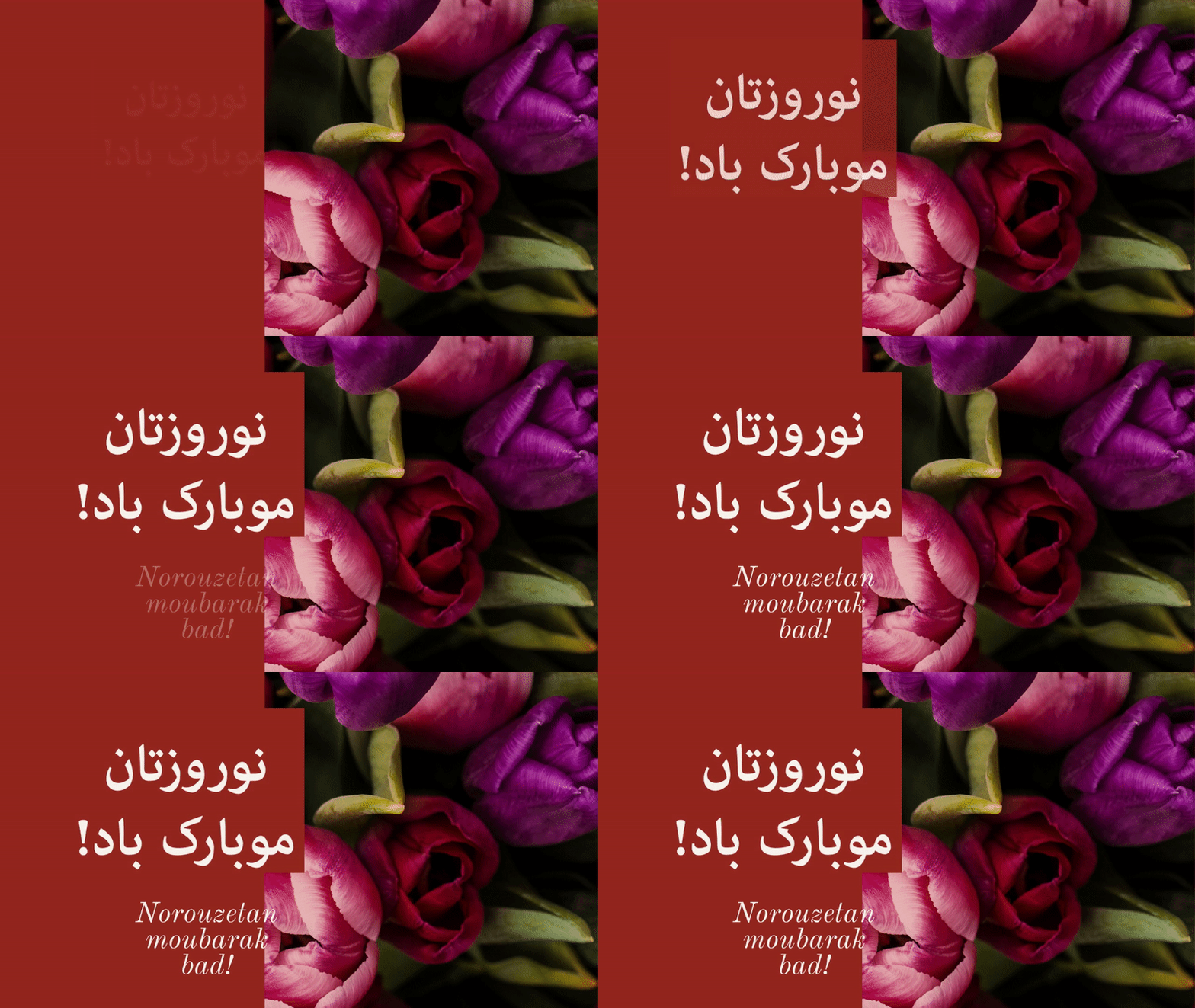
Nowruz is one of the oldest festivals that exist: Its origins seem to be in debate, but it seems to have been part of Zoroastrianism. It was first recorded in ancient Pahlavi texts, over 2000 years ago.
It’s a spring festival that celebrates the coming of the new year after winter.
It is celebrated inside and outside of Persia with ancient rites, joyful and full of hope.
Imagine a combination of Christmas and Easter: Houses will be cleaned from top to bottom and decorated with eggs, flowers and twigs indicating the coming of spring and hopes for plentiful harvests.
The so-called ‘sofre-e haft sin‘, a fine cloth decorated in a central place of a house or home, showing more decoration and seven (‘haft‘) special things symbolising wishes for a good year ahead, whose names each start with the letter ‘sin’ of the Persian alphabet.
People buy new clothes and little gifts.
The festival starts actually two days before the turning of the new year, the day called “chaharshanb-e suri”:
The last Wednesday before the new year, when people gather in the streets, light small bonfires and jump over them, saying proverbs: This custom meant to leave sorrow and unhappiness to the fire and let it transfer new energy to the jumping person.
After the turning of the new year for two weeks people visit each other, wearing their new clothes and bearing gifts, the rounds starting with the young visiting the older family members first. Sweets, fruit, and tea are common as repasts – and dancing is a matter of course.
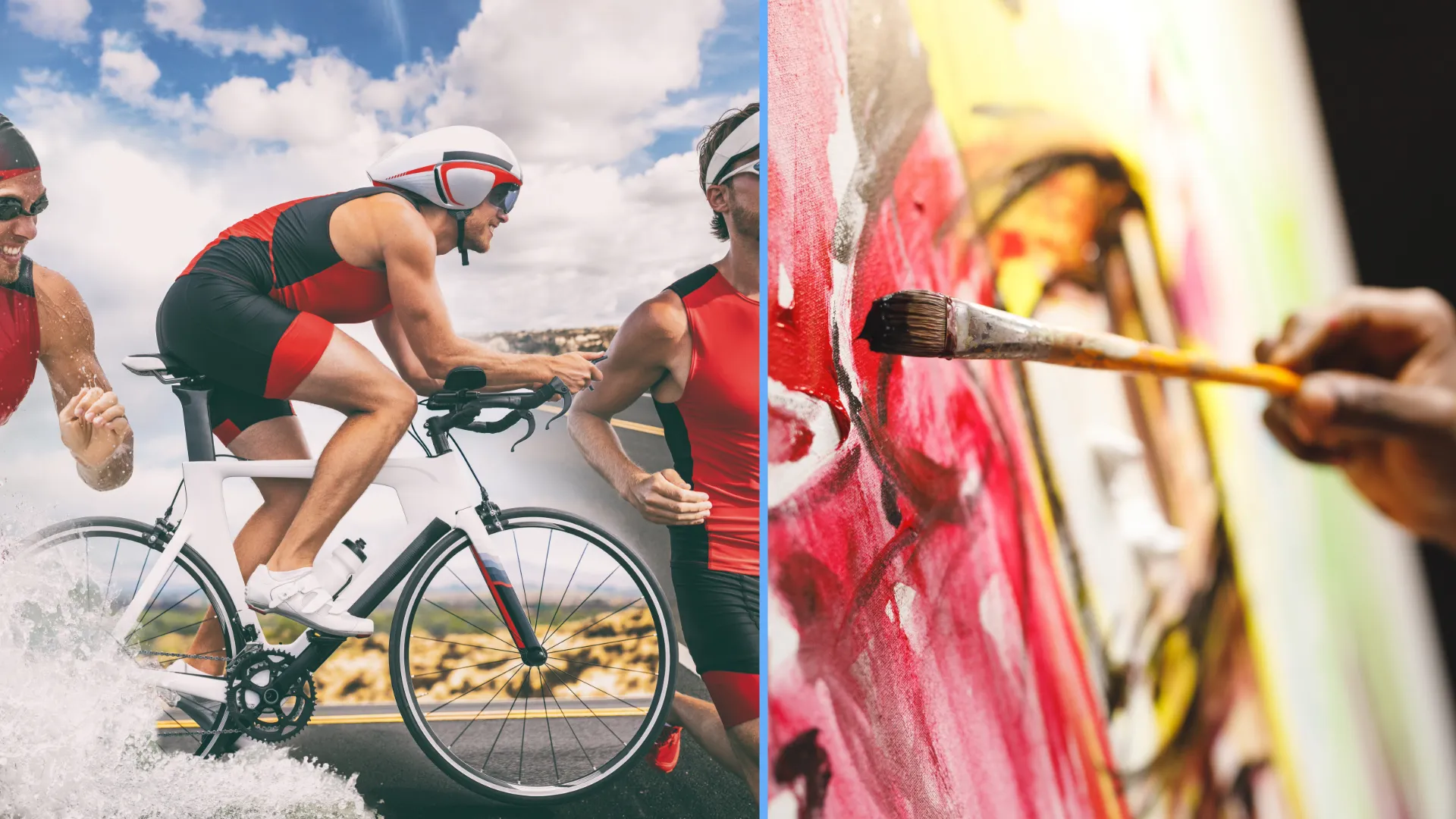
‘Iron Man’ is the name for a triathlon considered to be the hardest to stay the course or win, of all, annually taking place on Hawaii. Thus the name. Yet, as so often is the case, there is more to it than meets the eye: To be an ‘iron man’, a hard, muscular ‘hero-type’ of man seems still to be an ideal especially for men to attain.
What can easily be forgotten is the other side to human existence: The finer senses. The fact that human beings do not just consist of a number of muscles to be trained and displayed and used in a competition.
Humans have brains and hearts. The heart showing by beating faster, breath going stronger, what we feel and what often if not always starts in the brain: Emotions, passion, fear, joy, or excitement.
Those who say they are never afraid, are either dumb – or they lie. (NB)
Fear is one of those emotions that is never to be expected of the ‘iron man’, the hero, the ‘guy’. Always be cool and calm and collected, that’s the way to go – in patriarchy.
A comedian some years ago put it like this, too: “Anything men ever did in the course of human history was done to attract females.”
I believe he may be right…
That mistaken idea even some women still retain today – heroism showing itself like this: that men never should be sensitive, afraid, or vulnerable, is a great pity and a loss to our world.
Because many a hero was born for fear of being considered ‘too weak’. And the mistaken run for that ultimate goal, the ultimate ‘iron man’-medal can result in figures such as Trump or Putin: More power, more ‘say-so’, even inducing more fear in others.
To ‘cut a figure’, as the old phrase so nicely puts it.
I think that two things deserve our attention much more:
The men that actually take it on themselves to have a family and care for them. Teach their children that a man is more than just a ‘six pack’…
In general, face our prejudices and presumptions with some courage – and start to realize that neither men nor women ‘need’ to match all those criteria so often part of the cheaper type of movie or advertisement:
Always ‘cool, calm and collected’, always ‘happy, healthy and wealthy’… is just too much to expect.
Let’s start to be more human again. Although these thoughts and ideas have been raised before, being different, being an ‘artistic type’, or just being sensitive, still too often is considered unusual.
And still to this day the ‘hounds’ are called and let loose on those who represent in effect about one quarter of any human community: People very aware of the finer senses.
In other words as well: Let’s teach tolerance* to our children and grandchildren, respect for all those trying to make the world more colourful, interesting or just a little more joyful.
* “tolerancenoun (ACCEPTANCE)
willingness to accept behaviour and beliefs that are different from your own, although you might not agree with or approve of them”
(Cambridge Dictionary, Online version)
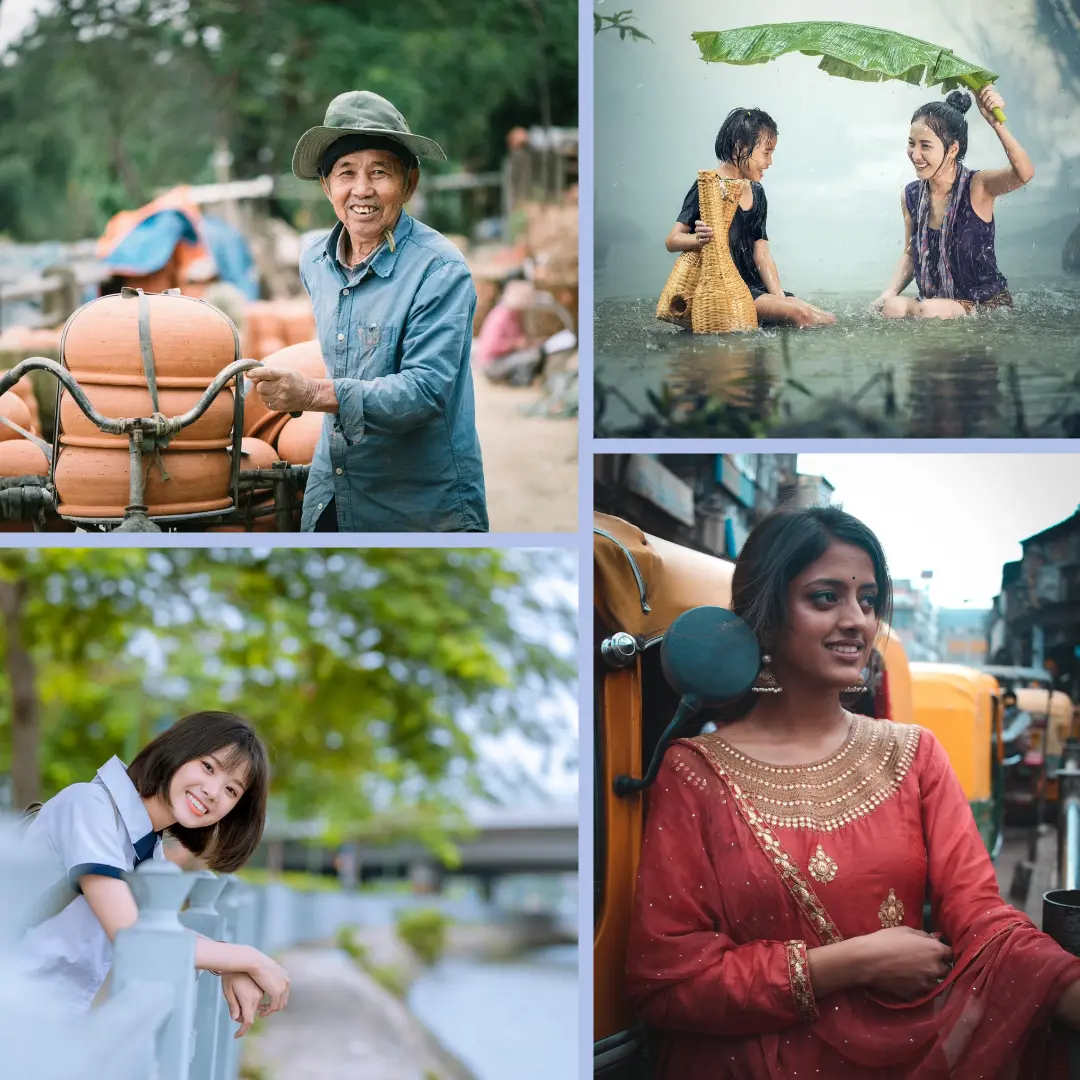
Image by Sasin Tipchai, Yogendra Singh, Hữu Thanh Cái and Tri Le from Pixabay, my arrangement
The smile of Asia as a phrase has been used in advertising – too. But the actual fact is also that in many countries around the world, especially in the Near or Far East, as they are called, smiling at others you never even met before is a custom.
People from other parts of the world often feel charmed and after a while even puzzled by these smiles. Aren’t we friends, when we smile? Or at least close?
There’s another fine line that Rudyard Kipling, English ‘poet laureate’ and award-winning writer, used in his book “Kim”:
“The indifference of native crowds he was used to. But this strong loneliness among white men preyed on him.”
If you have once encountered and actually felt that atmosphere and met people from those parts, you will come to realize that he was right. It feels exactly that way. That sense of community and friendliness, acceptance of others as human beings can be heart-warming.
I am not originally from anywhere close to those parts. But I have lived with and learned from the Persian culture for the better part of my comparatively long live.
I have come to appreciate that feeling. It is based on the idea, that we of course would need to really meet, get to know the other person in order to be friends. But that as human beings we can be close, because we are similar in our needs and wishes and sorrows and joys; we need each other, in troubled times as well as in joyful times.
According to that nice saying too:
“Sorrow shared is sorrow halfed. Joy shared is doubled joy.”
It can help also to (again) understand that in spite of the advantages the individualism in Western countries has brought, it can make people lonely. The pandemic has increased and sharpened that.
Perhaps the ideas we see daily actually ‘thrown’ at us all around the clock (if we don’t filter them), online that is, about being ever more optimized, the ‘perfect person’, make it more difficult.
The daily live in Asia has developed over thousands of years, climate and living conditions as well as ancient philosophy and customs are part of it. We can learn that:
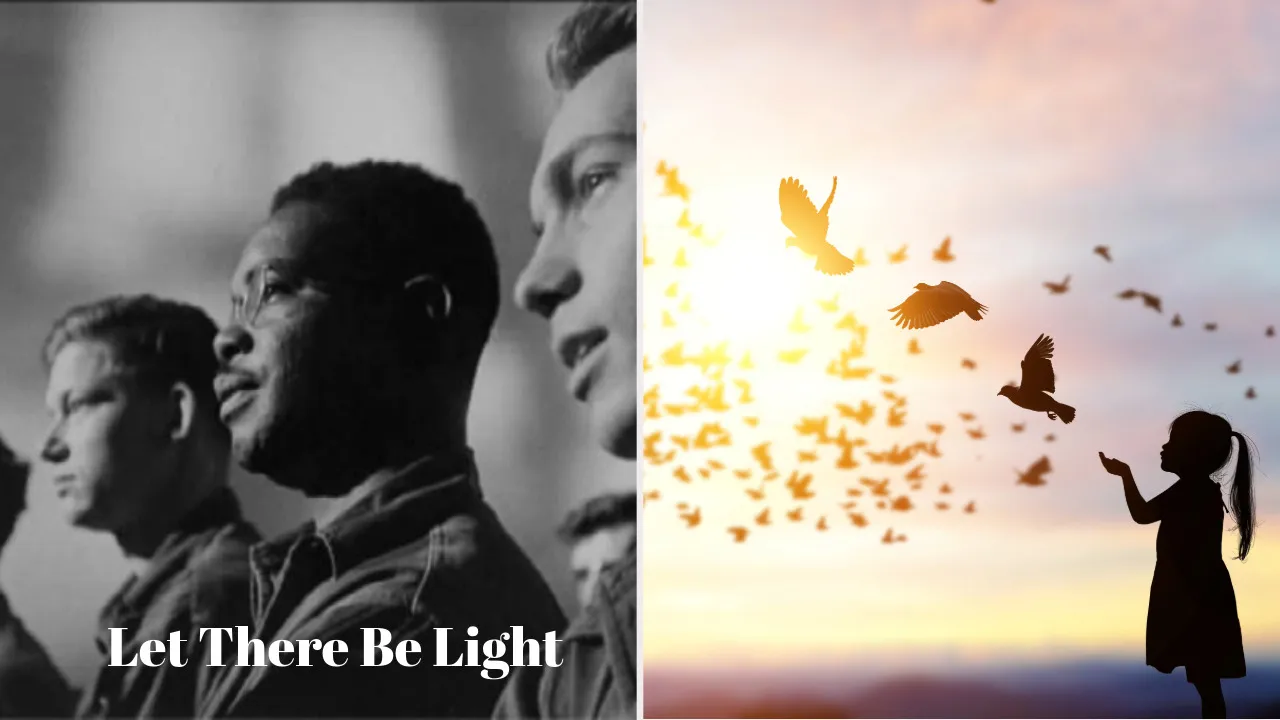
Images from the movie’s webpage and licensed via Adobe CC, my graphics – Documentary by John Houston, award-winning director, “Le There Be Light“, 1946
When you look into news and messages you will find that around war there still is a sort of halo or glow being created: As if it actually was about heroes, about being brave and strong and resilient in the face of adversity.
It’s not. It’s a means to an end. Sometimes more than one end.
Oil. Power. Money. … You name it.
Especially in these days, where more than half the world is online and rather better educated than ever before. Patterns of human behaviour are age-old and they repeat. But war is young in history, compared. And that’s a fact, stated by scientists and archaeologists of long standing.
Think of the hundreds of thousands of years that humans have been part of this planet.
Around ten thousand years are a pea on a hot plate in that respect.
There are a few very easy to follow arguments that support this view:
People who come back from war, alive, are scarred in their feelings and emotions, their souls, for the rest of their lives. One proof of that fact is shown with widely recognized precision and compassion in the documentary from 1946, created by John Houston about WW II soldiers, coming back.
But also in former times soldiers who came back would behave differently. Would be uneasy in everyday life and often become furious at any little thing. Turn to be alcoholics. The reports are legend. In literature and in chronicles.
In other words: If war was so natural, would people mind?
Again:
Conflicts are natural. Wars are not!
We can resolve conflicts, if we really want to, because there’s always another road.
Image courtesy music.apple.com – Click to listen to music on music.apple.com
Music is special. It seems that the earliest ways to express sound may be even older than human speech. Human speech developed over time, thousands of years at least, from earliest ways to express simple sounds through strings of combined sounds as first words, eventually shaping the first sentences.
Speech is nothing short of a miracle. So is human understanding. Because there are languages and cultures.
Music, in turn can sometimes help to bridge gaps. In understanding and realization. Music is actually another miracle, if you look at it closely. All across the world music has become a way to express feelings, emotion.
Love, friendship, sorrow and joy, fear and sadness, anger or fury; images that float through our minds can be triggered by listening to music. Some types of music have become universal and indeed can make people in concerts feel connected just by listening.
In recent decades the research into the helping and healing aspects music can have and thus be used for, have been made and recorded in the science of music therapy.
The above is one of my favourite albums of Persian music: Few types of music to my mind convey this close connection of sadness and joy actually at the same time: In traditional Persian music, possibly due to a very moving history, joy and sadness are presented in the tune as well as the rhythm, interchangeably.
So you can have a joyful rhythm and a sad tune that can render it perfect to help connect to those parts of our souls that cannot always be joyful; and yet remember that sadness and joy in life can be there at the same time and thus help. Be resilient.
“Zum Golde drängt, am Golde hängt doch alles
ach, wir Armen.”
“Towards gold all push, all is suspended by,
oi, wey our souls.” (Gretchen, Goethe, Faust I, my translation).
It’s the quintessential phrase in regard to many people’s image of their own value, their idea of their self-esteem: “The more money I get, the higher salary I receive, the better person I am.”
I feel lucky personally not to have been raised by such standards: Our parents from early on made clear that things are like this in a system that is based on ‘capital’:
That due to the human phenomenon of a system pervading the whole of life over time, many people feel like that:
More money = more self-esteem.
But, perspective is key: If we get the chance to ask further and develop our thoughts we can rise above that rather cheap concept – and find ourselves more than the sum of our parts – or the money.
The only thing remaining and rather important, alas, is to watch out for all those that don’t – or haven’t realized this. At times I pity them for the emptiness their life must present.
But looking after ourselves and protecting us from greed and selfishness where present is still the order of the day – too.
All the happier I am when I meet with the good ones…
I have posted about wars. This is about the smaller ones in everyday life. We can make an issue out of every little thing. Sometimes, people will misunderstand it if we don’t. I had to fight a lot in the course of my life. I learned one thing for sure:
Many things can become big, even huge in the eyes of the world ‒ or our own ‒ if we make them that. Fighting is proven to ‘take it out of you’: You can become angry, even furious once you have chosen the issue. You start an argument, perhaps. Things even may escalate into a full-blown conflict that rages for years.
And for what, really? So often we will come to realize that a lot of things are not worth the energy, because:
Fighting saps one’s strength.
I am not talking about becoming angry ‒ and letting off steam. That’s important in a healthy way and done safely in order to not hurt others.
But fighting?
Fighting takes it out of you, the effects can become really dangerous to our system. Because, the way we deal with anger or even frustration is something we can learn ‒ and manage. So much in life depends on how we look at it. Strong emotions are part of our mindset ‒ that is also: part of how we evaluate what happens to us.
The first flush of anger may be involuntary ‒ but after that, it’s a choice. To save health and nerves and keep frustration at bay.
Because, also, so often looking back, we may regret unnecessary fights, especially with people we like or love.
That’s why I make it a point in my life ‒ and a plea here for all who are wondering: Pick your battles. The next one may be really worth it.
Author’s Note:
I write about such things because I learned early in life how easily we all tend to make our life difficult or even hurt the other’s feelings without meaning to. Misunderstandings too, are easy. I have a strong background in workplace psychology, among many other fields of interest, be that history, philosophy ‒ or politics. I also have come across many misjudgements in life ‒ in private life or in business. Enlightenment is a philosophical approach and subject ‒ to me it is essential to understand ‒ and make understood.